
The Science of Reading: What Parents Should Know
If you've spent any time in a parenting group or scrolling through instagram accounts lately, you've probably seen the phrase "science of reading" everywhere. It can sound like a buzzword, or worse, like one more thing you're supposed to already understand to help your child learn to read.
Here's the good news: the science of reading isn't a curriculum, a trend, or a club you need a membership card for. It's simply decades of research into how the human brain learns to read, and what that research tells us is reassuring. Reading is a learned skill, not something children are born knowing how to do, and when it's taught explicitly and systematically, the vast majority of kids can learn to do it well.
As an SLP and a behaviour analyst who have spent years working alongside families, we want to break down what the research actually says, and more importantly, what it means for what you do at home this summer.
Reading Is Two Things, Not One
One of the most useful ideas to come out of reading research is what's called the Simple View of Reading. It frames reading comprehension as the product of two separate skills: word recognition (can your child sound out and recognize the words on the page) and language comprehension (can your child understand and make meaning from spoken and written language).
The important thing: both matter! A child who can decode every word but doesn't have the vocabulary or background knowledge to understand what those words mean will still struggle. And a child with a rich vocabulary who can't yet sound out words will also struggle, just in a different way. Strong reading depends on both halves working together.
Researchers often build on this with Scarborough's Reading Rope, which pictures these two strands, word recognition and language comprehension, as multiple smaller threads woven together: phonological awareness, decoding, and sight recognition on one side, and background knowledge, vocabulary, language structures, and verbal reasoning on the other. The rope gets stronger as those strands are practiced and woven together over time.
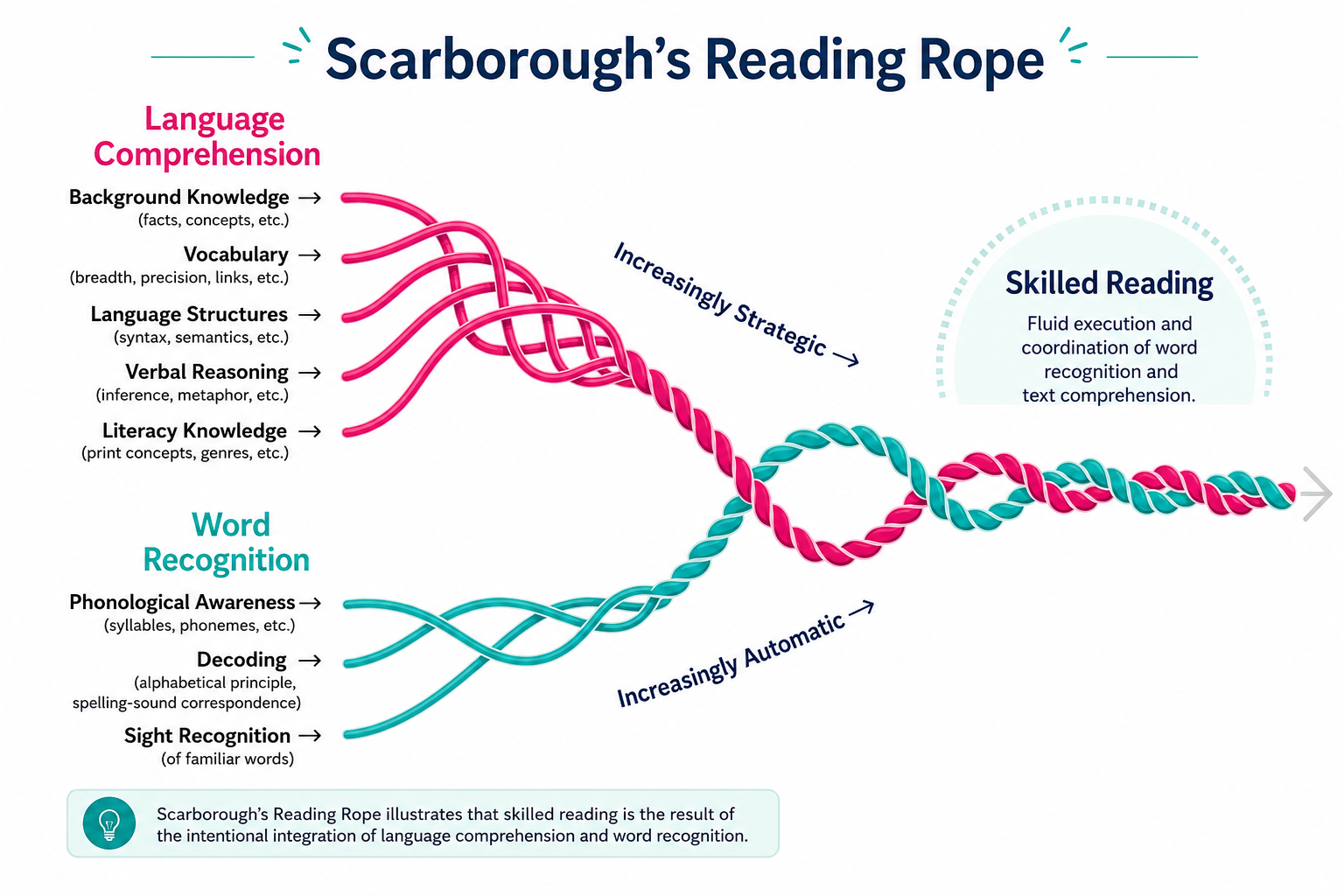
Reading Rope
What the Research Says About Teaching It
The research is fairly consistent on a few points. Phonemic awareness, the ability to hear and play with individual sounds in words, is one of the strongest early predictors of reading success, and it benefits from being taught explicitly rather than picked up incidentally. Systematic phonics instruction, where children are taught letter-sound relationships in a clear, logical sequence, consistently outperforms approaches that leave children to guess at words from pictures or context (HINT: don’t make your child “guess” the word just by looking at the pictures!).
Why Practicing to Read Is Genuinely Hard (And Why That's Okay)
We tell parents this all the time: learning to read is hard work for a young brain, and it is completely normal for kids to get frustrated, shut down, or want to quit halfway through a word.
This isn't a sign that something is wrong with your child. Decoding asks a five year old to hold several new skills in their head at once: recognizing letters, recalling their sounds, blending those sounds together, and then making sense of the result, all while sitting still and staying motivated. That's a lot to ask.
This is exactly why we build reading instruction gradually, skill by skill, rather than throwing everything at a child at once. Short vowels before digraphs. A handful of words before a full sentence. Three to five minutes of focused practice rather than a long session that ends in tears. When a task is broken down into pieces a child can actually succeed at, frustration goes down and motivation goes up. Confidence is built one small win at a time, and those small wins add up faster than most parents expect.
The Other Half: Read Above Your Child's Level
Here's something else that we always mention to parents... While your child is working hard on decoding simple, controlled words, you should also be reading them stories that are well above what they could read on their own.
This matters because of that second half of reading we talked about earlier, language comprehension. When you read aloud, your child gets access to story grammar (how a narrative is structured, with characters, a problem, and a resolution), richer vocabulary than they'd encounter in a beginner decodable book, and practice with skills like inferencing, predicting what might happen next, or figuring out how a character is feeling based on context. None of that requires your child to sound out a single word. It just requires you to read to them.
So a strong early literacy routine really has two tracks running side by side: short, focused decoding practice during the day, and rich read-aloud time at bedtime. Neither one replaces the other.
How We Work on This In Our Own Homes
A lot of these phonological awareness skills, rhyming, alliteration, noticing the sounds inside words, don't need a workbook at all. Some of our favourite practice happens in the car or on the living room floor.
We're BIG fans of Raffi. Songs like "Down by the Bay" are full of silly, made up rhymes like “a fly wearing a tie.” The song, "I Like to Eat Apples and Bananas" is a great, playful way to hear alliteration in action. Kids don't even realize they're building a reading skill. They just think it's a fun song!
In the car, we'll play "Willoughby Wallaby Woo" (another Raffi favourite) and then make up our own versions on the fly. "What rhymes with wommy?" turns into a whole game, and there's no wrong answer as long as your child is playing with sounds.
We also try to point out print wherever we go. The OPEN sign in a store window, the big yellow M for McDonald's, a stop sign at the corner. These small, repeated moments help kids start to understand that print is everywhere and that it carries meaning, long before they're ever asked to sound out a word on a page.
None of this requires sitting down at a table. It's the kind of thing you can fold into a regular afternoon, and it builds the exact phonological awareness foundation that decoding instruction later depends on.
What We'd Start With This Summer
If you're looking at the summer ahead and want to give your kindergartener a real head start on reading, here's what we'd recommend. Pair short, structured decoding practice with nightly story time.
For the decoding side, our Word Quest Short Vowels workbook was built specifically around these principles. It moves through short vowel sounds gradually, one pattern at a time, with phonics searches, word matching, word building, and short decodable sentences that only use words your child can actually sound out. Sessions are designed to be short and high-success, with a parent guide that walks you through how to support your child step by step, including specific strategies for kids who tend to get frustrated or avoid tasks that feel too hard. Our workbook is now available in print on Amazon here.
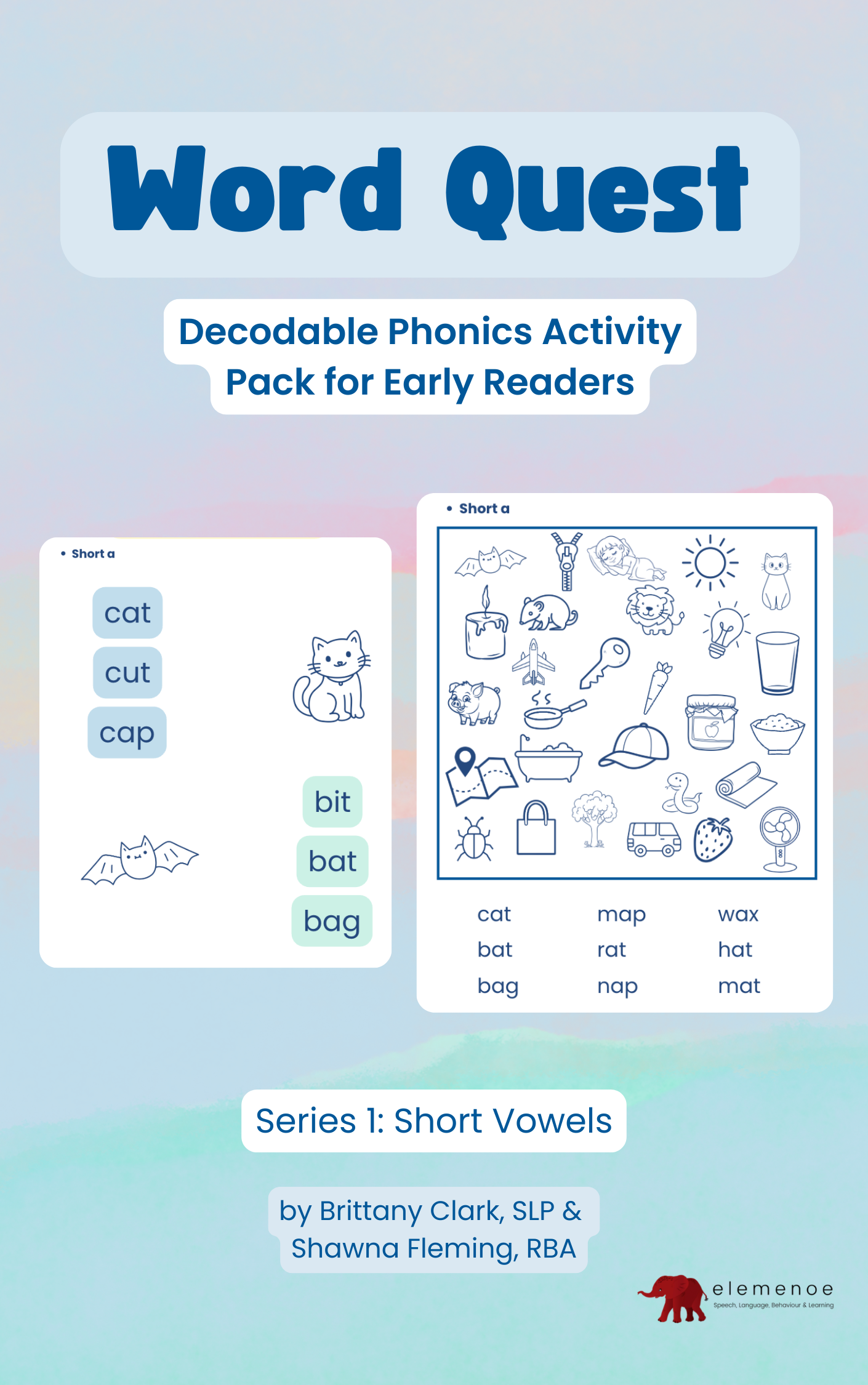
Word quest workbook
For the comprehension side, keep doing what you're already doing: read to your child every night, choose books a little above their level, and talk about what's happening in the story as you go.
Those two habits together, a few minutes of decoding practice and a story before bed, give your child both halves of what skilled reading requires. That's the foundation we'd want any child to start kindergarten or first grade with.
Written by Brittany Clark, SLP, and Shawna Fleming, Behaviour Analyst, Co-Founders of Elemenoe Speech, Language, Behaviour & Learning.