
10 Playful Ways to Teach Deep Breathing That Kids Actually Want to Try
“Take three deep breaths.”
If you’ve ever said this to your child and been met with an eye roll, dramatic flop, or a very loud “NO,” you are not alone.
Deep breathing is one of the most powerful nervous system regulation tools we have. But for many children, especially neurodivergent kids, being told to “just breathe” can feel boring, confusing, or even frustrating. The good news is that breath work does not have to be dull to be effective. It can be playful, imaginative, and even silly!
Why Deep Breathing Helps the Nervous System
When a child feels overwhelmed, frustrated, anxious, or overstimulated, their nervous system shifts into protection mode. Their heart rate increases. Muscles tighten. Thinking becomes harder. Big reactions happen fast.
Slow, intentional breathing helps activate the parasympathetic nervous system, which is the body’s calming system. It sends a signal that says, “You are safe.” With practice, deep breathing can:
Lower heart rate
Reduce muscle tension
Improve emotional regulation
Increase focus and flexibility
Support smoother transitions
Help children recover more quickly after big feelings
Deep breathing can also support communication. When a child’s body is calmer, it becomes easier to find words, listen, process language, and respond thoughtfully instead of reactively. For children who struggle with impulsivity, shutdowns, or emotional flooding, regulating the breath can create just enough pause to support clearer expression and more effective back and forth conversation.
Why Playful Works Better Than Boring
Children learn through play. Imagination creates engagement. Engagement builds repetition. Repetition builds skill.
When breathing feels like a game instead of a demand, children are far more likely to try it and use it independently. Playful breath work also supports kids who think visually, move frequently, or need sensory input to stay engaged.
Why This Matters So Much for Neurodivergent Kids
Many neurodivergent children, including those with autism and ADHD, experience the world with heightened intensity. Sensory input can feel louder, brighter, or more overwhelming. Transitions can feel abrupt. Emotions can rise quickly and powerfully.
For children with ADHD, breathing strategies can help slow impulsive reactions and improve attention by calming the body first. When the nervous system settles, the brain has more access to executive functioning skills like planning, flexible thinking, and self control.
For autistic children, predictable and rhythmic breathing patterns can feel organizing and grounding. Pairing breath work with visual, tactile, or imaginative elements often increases engagement and makes the strategy more accessible. Many autistic children also benefit from concrete, sensory based tools rather than abstract instructions. Saying “trace the square and breathe” is often much clearer than “calm down.”
Breathing can also support communication differences. When children with autism or ADHD feel overwhelmed, expressive language may become harder to access. Calming the nervous system can make it easier to retrieve words, tolerate frustration during communication breakdowns, and stay engaged in social interaction. Regulation supports connection, and connection supports communication.
Here are 10 creative, kid friendly alternatives to “take three deep breaths.”
1. Smell the Cupcake, Blow Out the Candle
Inhale slowly like you are smelling a warm chocolate cupcake.
Exhale gently like you are blowing out a birthday candle.
You can even hold up a pretend cake and candle with your hands. Make it silly by describing the scent of each cupcake.
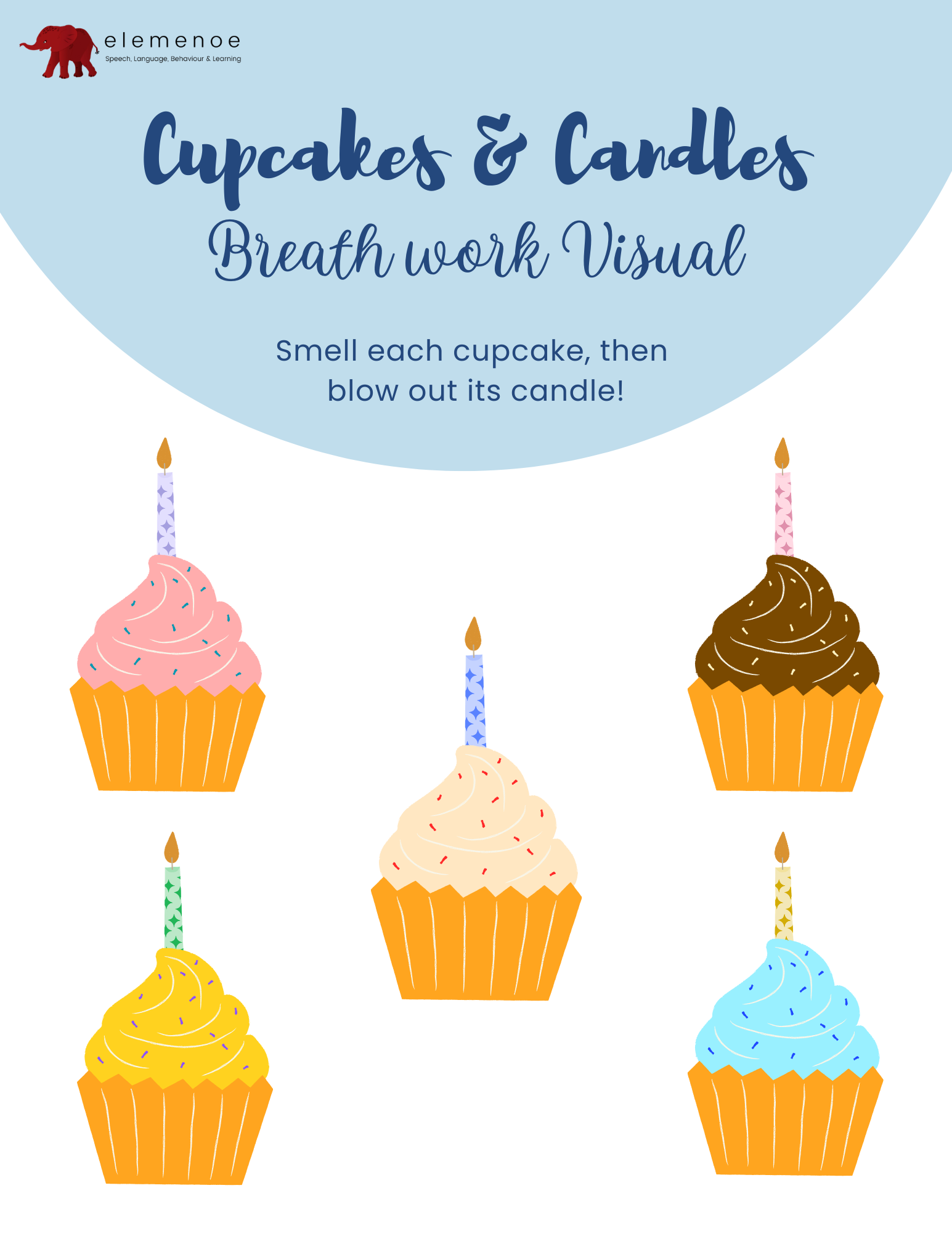
Cupcakes & Candles Breath work Visual
2. Hot Cocoa Breathing
Hold your hands like you are holding a mug.
Breathe in and smell the cocoa.
Blow out slowly to cool it down.
Add sound effects for extra fun.
3. Balloon Belly
Place hands on the belly.
Breathe in and inflate the belly like a giant balloon.
Breathe out and let the balloon slowly shrink.
You can guess what color balloon you are today.
4. Dragon Fire
Breathe in through your nose.
Breathe out slowly through your mouth like a gentle dragon releasing warm smoke.
For kids who need more sensory input, try making a soft “haaa” sound on the exhale.
5. Flower and Bubbles
Smell the flower.
Blow bubbles gently so they do not pop.
This works beautifully if you actually have bubble solution at home.
6. Square Tracing
Use a finger to trace a square in the air or on your palm.
Breathe in for one side.
Hold for one side.
Breathe out for one side.
Pause for one side.
This adds a visual and tactile component that many neurodivergent kids find regulating.
7. Stuffie Breathing Buddy
Have your child lie down and place a stuffed animal on their belly.
Watch the stuffie rise and fall with each breath.
Make it a challenge to give the stuffie a smooth and gentle ride.
8. Snake Hiss
Breathe in through your nose.
Breathe out slowly while making a long “sssssss” sound like a snake.
See how long the hiss can last. This naturally lengthens the exhale.
9. Rainbow Breathing
Use your finger to draw an invisible rainbow in the air.
Breathe in as you trace up one side.
Breathe out as you trace down the other side.
You can name a different color each time.
10. Five Finger Breathing
Spread one hand out like a star.
Use the other finger to trace up and down each finger.
Breathe in as you trace up.
Breathe out as you trace down.
This is especially helpful in classrooms or public spaces because it is quiet and subtle.
A Gentle Reminder for Parents
Breathing tools work best when practiced during calm moments, not just during meltdowns. Think of it like building a muscle. The more playful practice your child gets when they feel safe and connected, the more likely the skill will show up when big feelings arrive.
Regulation is relational. Your calm presence, your playful tone, and your willingness to join in often matter more than perfect technique.
Psychotherapy at Elemenoe
If you are looking for support helping your neurodivergent child build emotional regulation and communication skills in ways that feel respectful, creative, and brain friendly, we would love to connect.
Tayler Evans is a Registered Psychotherapist (Qualifying) at Elemenoe. Tayler provide in-person virtual therapy for neurodivergent children, youth, and families across Ontario. You can learn more about our services or reach out for a consultation at https://www.elemenoe.ca/psychotherapy. We would be honoured to support your family.
Until then, go smell some sweet cupcakes and blow out the candles together 💛