
Bedtime Without Battles: Why We Created Our Learning Contacts Toolkit
If bedtime feels like the moment your whole day unravels, you’re not alone.
For a lot of families, it’s not the routine that’s the problem…. it’s the transition. The timer goes off, the lights are about to go out, and suddenly your child’s body is in full protest mode. Tears. Yelling. Bargaining. Running out of the room. And you’re standing there thinking, Why is this so hard? We do this every single night.
We made this toolkit because we’ve been there too…. this toolkit actually started at home.
Shawna (behaviour analyst) hit a point with her 5-year-old son where bedtime had become a nightly battle. Not a little resistance, but the kind of struggle where everyone ends the night in tears. Her son would fall apart when the lights went out, and Shawna would end up feeling stuck between two impossible choices:
Push through and feel like the “bad guy”
Back off and feel like bedtime would never get easier
And the hardest part? It wasn’t that he was being “difficult.” It was that he was having a hard time.
That’s the piece we want to name clearly: when kids melt down at bedtime, it’s often not about defiance. It’s about a nervous system that can’t handle the shift from “fun and connection” to “stop and separate.”
Why we didn’t start with a sticker chart (and what we focused on instead)
Sticker charts and reward systems can be helpful in the right context. They can increase motivation and reinforce skills that are already within a child’s reach.
But that wasn’t what was happening here.
This wasn’t a situation where Shawna’s child wouldn’t go to bed. It was a situation where he couldn’t get through the transition without becoming overwhelmed.
Even though we had talked about expectations ahead of time, his body was still going into a full stress response when the lights went out. That told us something important: this wasn’t just about motivation or cooperation, it was about regulation.
And when a child is dysregulated, adding a reward after the fact doesn’t teach the skill they’re missing in the moment.
In this case, the skill we needed to support was:
tolerating the transition from connection to separation
managing big emotions at lights-out
feeling safe and predictable in the routine
Before we could expect independence, we needed to build capacity.
That’s why we focused first on an antecedent strategy, something that happens before the behaviour. We needed a way to:
Understand from the child’s point of view where this was going wrong
make the transition more predictable
reduce the emotional load of bedtime
and give our child a sense of understanding and control
A reward system could have been layered in later. But at that point, it would have been asking him to “earn” something before he had the tools to be successful.
That’s where the learning contract came in.
Not as a compliance tool, but as a collaborative way to:
explain what was happening in a way he could understand
co-create a plan for the hard moments
and make expectations feel clear and supportive
It helped us move from: “Why is this happening every night?” to “Okay, this is what your body is telling us, and here’s how we can handle it together.”
The shift: doing bedtime together
What changed things was moving from “I’m trying to get you to do bedtime” to “Let’s make a plan we both understand.” That’s where learning contracts (also known as behaviour contracts in the literature) came in.
A learning contract is a simple, written agreement that makes the routine visible and predictable. But the magic isn’t the paper… the magic is the conversation.
When Shawna sat down with her son, calm, during the day, not in the middle of bedtime stress, it created space for both perspectives to matter.
Together, they explored:
why bedtime hadn’t been working (from both sides)
what he wanted bedtime to feel like
what still needed to happen
what felt hard about lights out
and what might help him feel more ready
This wasn’t about winning. It was about understanding and building a plan together.
And for a 5-year-old, that matters.
At this age, kids are developing independence, but they still rely heavily on co-regulation, structure, and a sense of shared control. When we invite them into the process, we’re not “giving in”, we’re building essential skills. They begin to make sense of what’s happening in their body, communicate their needs more clearly, and learn how to work within expectations, even when something feels hard.
They’re not just getting through bedtime, they’re learning how to navigate it.
Why this works (in real life, not just on paper)
From a behaviour lens, learning contracts work because they reduce uncertainty and make expectations concrete.
From a parenting lens, they work because they reduce the emotional load on everyone.
Here’s what we saw shift when this became a shared plan:
Less arguing at the timer
Fewer surprises (“Wait, what? Bedtime already?”)
More follow-through because the steps were clear
More confidence for the child (“I know what to do next”)
More steadiness for the parent (“I don’t have to improvise this every night”)
And importantly: it created a way to talk about bedtime before bedtime.
That’s where the learning happens. This isn’t about compliance. It’s about success.
We want to be really clear about our “why.”
We didn’t create this toolkit to help kids have “good behaviour.”
We created it to help kids feel:
Prepared
Capable
Understood
Successful
And to help parents feel:
Less alone
Less reactive
More confident
More connected
Bedtime shouldn’t feel like a nightly test you’re failing. It should feel like a routine your family can hold. If bedtime is hard in your house, start here.
If you only take one thing from this blog, let it be this:
Don’t wait until the lights are going out to solve bedtime.
Have the conversation earlier.
Make the plan together.
Keep it child-friendly, age-appropriate, and compassionate.
That’s exactly what our Bedtime Without Battles: Learning Contracts Toolkit (Bedtime Edition) is designed to support.
Download the toolkit
If you want something you can use right away, download the toolkit here.
Inside, you’ll find:
A simple explanation of learning contracts (in plain language)
A step-by-step way to build one with your child
A bedtime contract template you can print or copy
Visual supports (because words alone aren’t always enough)
Tips for troubleshooting, motivation dips, and fading supports over time
If you need more support, we’re here!
Some seasons of bedtime need more than a template, especially if your child is in a high-stress phase, you’re seeing big distress, or you’re not sure what the behaviour is communicating.
If you’d like support that’s tailored to your child (and to you), our team is here.
Learn more about our services at https://www.elemenoe.ca or reach out to us at info@elemenoe.ca .
Disclaimer
This toolkit is for general educational purposes only and is not a substitute for professional assessment, diagnosis, or treatment.
If you have concerns about your child’s development, behaviour, sleep, or mental health, please contact your family doctor or primary care provider for guidance and next steps.
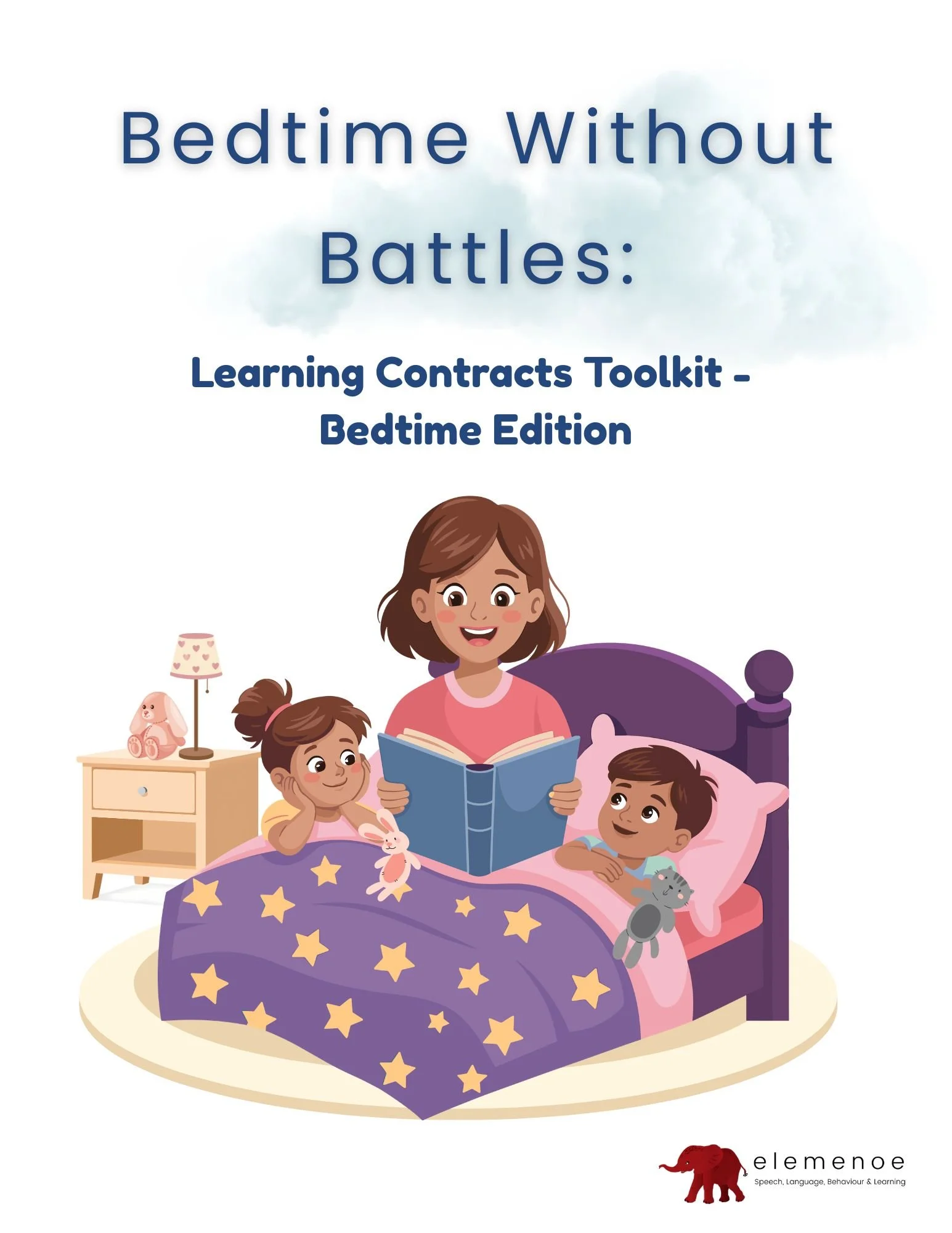
Bedtime battles toolkit